Local Models Behind Your Own API: Self-Hosting and Hybrid Routing
The rise of high-quality open-weights Large Language Models (LLMs) has fundamentally changed the generative AI playing field. Where we were previously exclusively dependent on proprietary APIs from major cloud providers, it is now possible to run models with comparable performance in-house. Self-hosting models like Llama, Mistral, or Qwen offers unprecedented control over data and infrastructure.
Yet, transitioning from an external cloud API to a self-hosted solution is no trivial step. It requires hardware insights, in-depth knowledge of inference optimization, and a well-thought-out architecture to ensure smooth integration with existing applications. In this article, we dive into the business case for self-hosting, the underlying technology of an inference server, and how to set up a scalable, hybrid architecture.
The Strategic Choice: When Does Self-Hosting Pay Off?
Before we dive into the technical details, it is important to make the business case. Managing your own GPU infrastructure (whether on-premise or via dedicated cloud instances) comes with fixed costs and operational overhead. When does the scale tip in favor of self-hosting?
1. Data Privacy and Strict Compliance
For many organizations in regulated sectors, such as healthcare, financial services, or government, sending sensitive personally identifiable information (PII) or business-critical data to an external API is simply not an option. Although many commercial API providers promise 'zero data retention', the data still leaves the internal network. A locally hosted model guarantees that data remains within your own firewall, which significantly simplifies compliance with frameworks like the GDPR and ISO 27001.
2. Total Cost of Ownership (TCO) at Scale
The pricing model of commercial APIs is based on 'pay-per-token'. For experiments and low-volume applications, this is highly cost-effective. However, as soon as an application scales and processes millions of tokens per day, costs rise linearly. When self-hosting a model, the cost structure shifts from variable costs to fixed costs (renting or purchasing GPUs).
Here, we assume that the hardware is continuously utilized efficiently. If you rent a GPU server for a fixed monthly fee and can utilize this server to its full capacity with requests 80% of the time, the price per generated token often drops to a fraction of what commercial APIs charge. The tipping point varies by model size, but typically lies with applications that run a continuous stream of background tasks (such as batch processing of documents).
3. Latency and Network Overhead
For real-time applications, every millisecond counts. An external API call introduces network latency. By hosting a model in the same data center or virtual network as the rest of the application, the Time To First Token (TTFT) is theoretically reduced. Note: local inference is only faster if the underlying GPU hardware and inference software are optimally configured. An unoptimized local model on weak hardware will still be slower than an optimized cloud API.
Conceptual Inner Workings of an Inference Server
Downloading a model and running it in a Python script is simple. Efficiently serving dozens of concurrent users via an API is a completely different ball game. This is where the inference server (such as vLLM, Text Generation Inference (TGI), or similar frameworks) comes into play.
GPU Utilization and the Memory Wall
When generating text (inference), the GPU is usually not limited by computing power (compute or FLOPS), but by memory bandwidth. This is known as the Memory Wall. During the generation of each new token, the parameters of the entire model must be moved from the video memory (VRAM) to the GPU's computing cores. The larger the model, the more data must be squeezed through the memory bus per token. The key to an efficient inference server is therefore optimizing VRAM usage and memory access.
Continuous Batching and PagedAttention
To improve the ratio between memory access and computing power, we group requests. This is called batching. Traditional (static) batching waits until a group of requests is finished before starting a new group. This is inefficient because generating a response for one request might take 10 tokens, while another takes 500 tokens. The GPU then sits idle waiting for the longest request.
Modern inference servers use Continuous Batching (or in-flight batching). As soon as one request in the batch is finished, the freed-up space is immediately filled with a new incoming request in the next iteration. This keeps GPU utilization constantly maximized.
This does require complex memory management for the so-called KV cache (the memory where the conversation context is stored). Frameworks solve this using PagedAttention. Inspired by virtual memory management in operating systems, PagedAttention divides the KV cache into small, non-contiguous memory blocks (pages). This prevents VRAM fragmentation, allowing you to process much larger batches and drastically increasing throughput (the number of tokens per second for the entire server).
Quantization: Doing More with Less Hardware
Another crucial technique for local APIs is quantization. By default, model weights are stored in 16-bit floating-point numbers (FP16 or BF16). By compressing these weights to 8-bit or even 4-bit (for example, via AWQ, GPTQ, or EXL2 formats), you halve or quarter the required VRAM. Because the Memory Wall is the biggest bottleneck, quantization not only ensures that large models fit on cheaper GPUs, but also significantly speeds up token generation, simply because less data needs to be transported over the memory bus. For a broader fundamental explanation of this, you can visit leren.llmnet.nl for an introduction to quantization.
Standardization: An OpenAI-Compatible Interface
When running a local inference server, it is highly recommended to use an API interface that is compatible with the OpenAI specification. Virtually all modern ecosystems, libraries (such as LangChain or LlamaIndex), and applications are built around this standard.
An OpenAI-compatible inference server accepts JSON payloads on an endpoint like /v1/chat/completions with the familiar structure of messages (with roles like system, user, and assistant). The major advantage of this is that your application code does not need to change when you switch models.
{
  "model": "meta-llama/Meta-Llama-3-8B-Instruct",
  "messages": [
    {"role": "system", "content": "You are a helpful assistant."},
    {"role": "user", "content": "What is the benefit of self-hosting?"}
  ],
  "temperature": 0.7,
  "max_tokens": 512
}
By using the same interface locally as external cloud providers, you create an abstraction layer. This prevents vendor lock-in; whether your API communicates under the hood with a local Llama 3 installation or with an external provider, your application won't notice the difference. This foundation is essential for setting up robust integrations in production environments.
Hybrid Architecture: Routing Between In-House and External Models
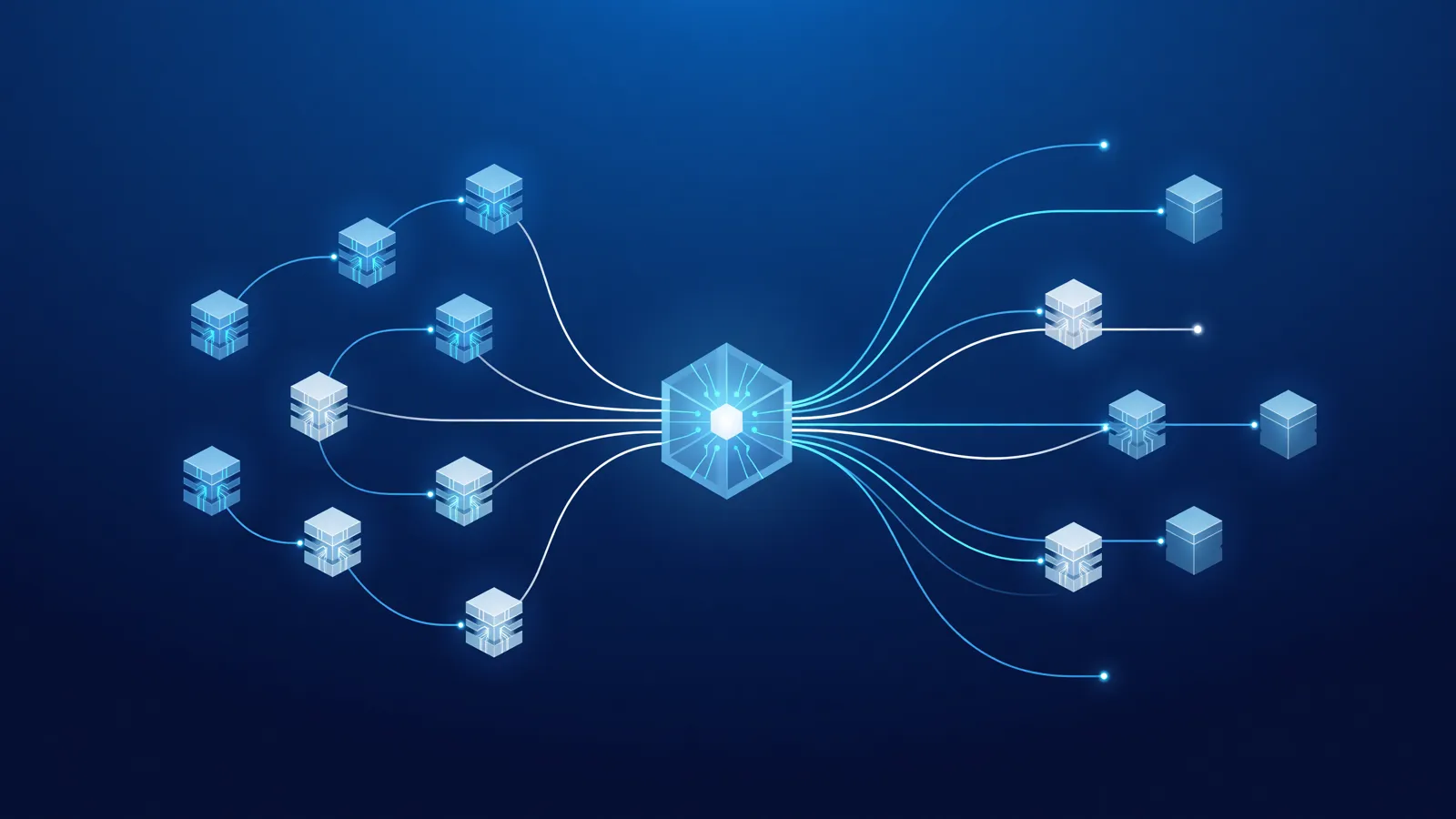
In practice, an 'all-or-nothing' approach (fully local or fully cloud) is rarely the best solution. The most cost-effective and resilient setup is a hybrid architecture. In this setup, a central component acts as the 'traffic controller' between different models.
The Gateway Pattern for LLMs
By introducing an API Gateway specifically for LLMs, you create a single entry point for your entire organization. This gateway implements the OpenAI-compatible interface, but instead of generating a response directly, it forwards the request to the most suitable backend. Read more about setting up this pattern in our article on self-hosting an LLM gateway.
Smart Routing (Routing Strategies)
With a gateway architecture, you can implement powerful routing logic. Some common patterns include:
- Privacy-based routing: A lightweight component analyzes the prompt for potential PII (such as social security numbers or medical terms). Does the prompt contain PII? Then the request is irrevocably routed to the local, secure model. Is it a general question? Then it may go to an external, potentially cheaper cloud API.
- Complexity-based routing: Simple tasks, such as extracting entities from text or simple translations, are handled by a fast, local (smaller) model. Complex reasoning problems or advanced code generation are forwarded to a heavy frontier model in the cloud. This process is also known as model routing.
- Fallback and High Availability: If your own local GPU server becomes overloaded (rate limits) or goes offline, the gateway can automatically forward the request to an external API as a fallback mechanism, without displaying an error to the end user.
Conclusion and Next Steps
Placing your own local models behind a company-wide API is a strategic move that delivers control, privacy, and, at sufficient scale, significant cost savings. However, it does require understanding the hardware implications (such as the memory wall) and utilizing modern inference techniques like continuous batching and quantization.
You unlock the true power by not running these local models in isolation, but by placing them in a hybrid network via an OpenAI-compatible gateway. This seamlessly combines the data sovereignty of local models with the raw computing power of cloud-based frontier models. For organizations looking to scale seriously with AI, this vendor-neutral pattern represents the most future-proof architecture.